
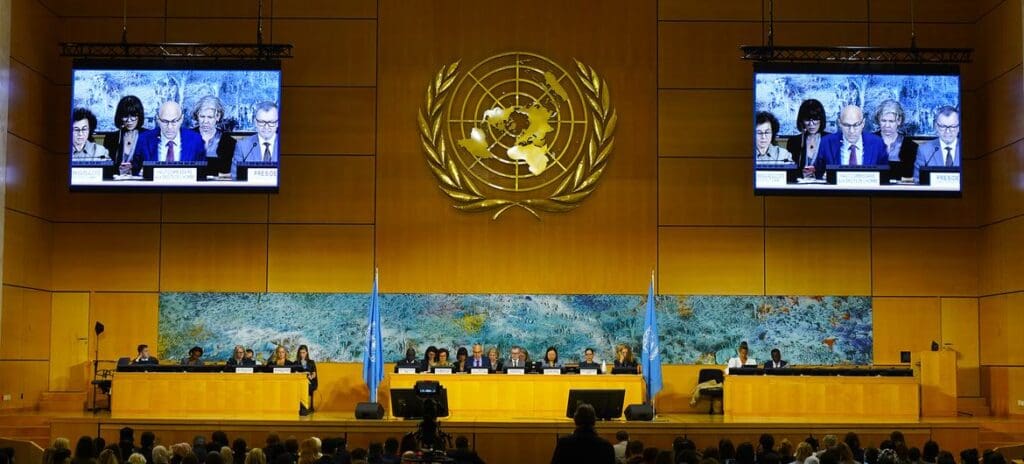
UN Geneva | The Human Rights Council meets in Geneva. On Monday, UN Secretary-General António Guterres appealed to the international community not to let the erosion of human rights become the accepted price of political expediency or geopolitical competition.
Doing what’s right is ‘not a spectator sport’, Human Rights Council warned
In Geneva, delegates from more than 120 countries gathered on Monday to mark 20 years of the UN Human Rights Council and a shared commitment to international law, amid runaway global instability, wars and resurgent conflict.
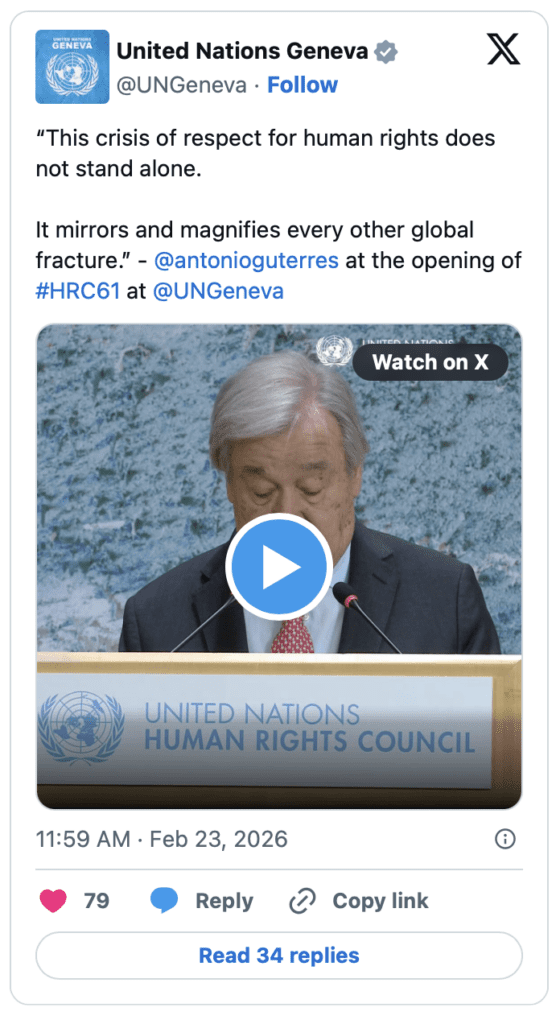
Acknowledging dizzying geopolitical uncertainty marked by conflict in Gaza, Myanmar, Ukraine, Sudan and beyond, Secretary-General António Guterres urged the Council to hold the line on human rights, which he warned were under a “full-scale attack…often led by those who hold the greatest power”.
On Ukraine, specifically, the UN chief noted that Tuesday 24 February will be the fourth anniversary of Russia’s full-scale invasion of Ukraine, which has killed more than 15,000 civilians. “It is more than past time to end the bloodshed”, he insisted, his comments a precursor to those of UN human rights chief Volker Türk, who called for rights and justice to be the focus of any ceasefire or peace agreement.
‘Silence has consequences’
Echoing those concerns, President of the UN General Assembly Annalena Baerbock insisted that human rights were “not a spectator sport” for Members of the Council, ambassadors, ministers or UN officials, for whom “silence is a choice…and it has consequences”.
“History teaches us that large systems rarely collapse in one dramatic moment; they erode slowly, rule by rule, commitment by commitment, with those who should defend them rather staying silent. Until one day, what seemed permanent simply vanishes,” Ms. Baerbock said.
In her opening comments, she highlighted the ongoing plight of Afghan women who under a new Taliban edict can reportedly be beaten by their husbands, so long as there are no visible marks.
“We should remember once and for all and again that appeasement in the light of the most severe human rights violations never prevails,” she said. “We are seeing not only a dramatic backlash in women’s but also human rights and other rules and standards which were believed to be set in stone and are now openly questioned, dismissed, or violated.”
Ukrainian children spotlight
The General Assembly President also appealed for “a clear commitment from every Member State that the abduction of Ukrainian children is a war crime”, a reference to the youngsters separated from their families since 2014 – when Moscow annexed Crimea – including those transferred within occupied Ukrainian territory and those deported to Russia.
Two-State solution ‘stripped away’
On the occupied West Bank where Israeli settler expansion is accelerating, Mr. Guterres warned that the two-State solution was being “stripped away in broad daylight. The international community cannot allow it to happen.”
And amid multiplying conflicts where aggressors continue to act with impunity, Mr. Guterres maintained that this was because governments continued to ignore fundamental human rights enshrined in international law, at a time when needs are “exploding” and funding is collapsing.
Inconvenient truths
“We are living in a world where mass suffering is excused away, where humans are used as bargaining chips, where international law is treated as a mere inconvenience,” he insisted.
In his last speech to the Council as UN Secretary-General before his second five-year term ends on 31 December, Mr. Guterres reiterated his long-held concerns about the drivers of insecurity and inequality which had left migrants “harassed, arrested and expelled”, refugees scapegoated and LGBTIQ+ communities vilified.
“Countries are drowning in debt and despair, climate chaos is accelerating,” he maintained, particularly small and vulnerable nations starved of adequate investment.
AI faultlines
Even technology – and especially artificial intelligence – is increasingly being used to “suppress rights, deepen inequality and expose marginalized people to new forms of discrimination both online and offline”, the world’s top diplomat warned, before urging a renewed commitment to the values of multilateral solidarity set out in the UN Charter.
“Human rights are not West or East, North or South, they are not a luxury, they are not negotiable. They are the foundation of a more peaceful and secure world. And States are bound by their obligations under the Charter and international law.”
Expanding on that theme, UN rights chief Türk said that at a time when some governments were weakening the multilateral system, violations of international law needed to be called out, “regardless of the perpetrators”.
To confront today’s “top-down domination”, the High Commissioner noted the upcoming launch of his Office’s Global Alliance for Human Rights, bringing together States, businesses, cities, philanthropists, scientists, artists, philosophers, young people and civil society.
“Our future depends on our joint commitment to defend every person’s rights, every time, everywhere,” Mr. Türk insisted.