
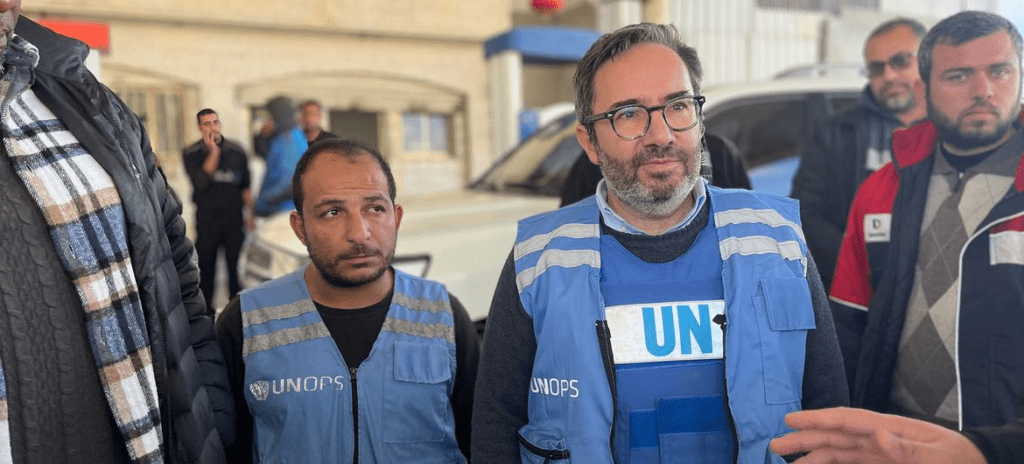
UN News | Moreira da Silva (right), Executive Director of UNOPS on a visit to the Gaza Strip.
Strait of Hormuz: With hunger looming, life-saving fertiliser shipments cannot wait, head of UN task force says
As the Persian Gulf crisis continues, the clock is ticking for farmers who rely on fertilizer shipped via the Strait of Hormuz – and millions worldwide who depend on their crops, particularly in vulnerable countries such as war-torn Sudan.
In normal times, one third of global fertiliser trade – along with 35 per cent of crude oil and a fifth of liquified natural gas – passes through the maritime corridor located south of Iran, but tanker traffic has essentially come to a standstill.
In response, United Nations Secretary-General António Guterres established a task force to facilitate the safe passage of fertilisers and related raw materials for humanitarian purposes.
It is headed by Jorge Moreira da Silva, Executive Director of the UN Office for Project Services (UNOPS), which provides infrastructure, procurement and project management services across the world.
“We cannot afford to wait,” he said in an exclusive interview with UN News.
“The planting season is upon us, and the risk of a major food crisis is real. We need the support and the cooperation of all stakeholders to make this mechanism a success.”
He told Reem Abaza that the UN task force he is leading will be able to get its “one stop platform” up and running in just seven days, if combatants blocking the strait allow fertilizers and other raw material through, to benefit the world’s most vulnerable.
The interview has been condensed and edited for clarity
Jorge Moreira da Silva: The idea of the task force was to develop a mechanism focused on fertilizers and related raw materials such as urea, sulphur, and ammonia, to prevent a massive humanitarian crisis. We have one-third of all fertilizers in the world going through the Strait of Hormuz, so you can see how important the Persian Gulf is for the production of fertilizers and how impacted is the entire supply chain of fertilizers with the disruption of the Strait of Hormuz.
If we don’t get some solution immediately, the crisis will be very significant and severe, particularly for the poorest countries and for the poorest citizens
But we also know that there are some countries that are more dependent on those fertilizers. Unfortunately, some of those countries were already highly vulnerable due to previous shocks, such as Sudan, Somalia, Mozambique, Kenya, Sri Lanka. These are just a few countries that are high importers of fertilizers coming from the region.
UN News: We’re talking about a time-sensitive period because it is the agricultural season in some parts of the world, and not having fertilizers will have a huge effect on food security. But how fast can you be operational?
Jorge Moreira da Silva: The point of speed, as you mentioned, is a critical one. Diplomacy and nature do not have the same speed. And I know that there are diplomatic efforts towards a political solution for the Middle East, and for this war, to have a lasting peace.
But the point that I’ve been making is we can’t wait until everything is fixed to at least get something fixed in time for the planting season. The planting season has already started, and in most countries in Africa it will end in May. So, if we don’t get some solution immediately, the crisis will be very significant and severe, particularly for the poorest countries and for the poorest citizens.
I want to stress one point. The mechanism is not a way to compromise or challenge the freedom of navigation. Freedom of navigation is an indisputable principle, and the Secretary-General and I have been very clear in stating the need to reinstate the freedom of navigation.
But what we are saying is: while we don’t have that freedom of navigation fully embedded and established because there are these negotiations in the context of the war, at least let’s have a time-bound, exceptional, limited mechanism just for fertilizers and related raw materials because this will still be in time for the planting season.
UN News: But for this mechanism to be operational, you need the consent of the main parties right now, and I’m sure you are in 24/7 discussions with everyone, how are these discussions going?
Jorge Moreira da Silva: First point, still on the speed, how much time would we need if we get a political deal as you mentioned, so if we have a decision by member states that they are in agreement of a mechanism, how much time from an operational point of view we would need?
We would need seven days. So, my team has already identified, the UNOPS team, has already identified in the context of the task force that includes the other agencies, the practical elements that are needed.
The development of a one-stop platform to approve all the shipment through the Strait of Hormuz and also monitors on the ground. We have identified all the needs, and my commitment is in seven days, if we get the deal, in seven days we’ll get the people on the ground ready to do this kind of facilitation.
I always say that if the mechanism is not needed, it’s good news. If there is a solution that doesn’t require the mechanism, it is because the freedom of navigation was re-established and we don’t need a mechanism for the fertilizers. But in case we don’t get a good outcome on the overall negotiations for peace and for the full reopening of the Strait of Hormuz, the UN is ready, if Member States want, to go quickly into this operation on the fertilizers to prevent a massive humanitarian crisis.
UN News: You mentioned verification, registration, monitors as well. It seems like a huge operation. Do you have all the resources needed for this mechanism to be operational soon?
Jorge Moreira da Silva: I think that the issue will not be the resources, this won’t require many resources, it would require political will. I think the most relevant resource that is needed for this initiative is the political will.
I would say the moment we have the political will of allowing a mechanism like this that doesn’t put in question the freedom of navigation but allows us to start immediately with the fertilizers. I’m sure that the resources will come. I have several delegations that already express their readiness to support and I’m telling that, well, please hold. We need first to get an agreement and then we will be very much welcoming your support also on the resources.

UN News: For someone who is listening to us right now, how would you explain how important this is to work right away? What does it mean for vulnerable people across the world if this didn’t happen, or isn’t operationalized soon? And why does the UN have to be the entity to manage it?
Jorge Moreira da Silva: Well, in terms of relevance, I would say that FAO and the World Food Programme have been very eloquent explaining the relevance of fertilizers for agriculture, yields and productivity.
Fertilizers bring some components, some ingredients that allow the plants to grow faster and to have better productivity. This is particularly important in some countries whose conditions are already fragile due to climate change. And we know also that if you don’t get productivity on agriculture, you will have food insecurity, hunger and starvation.
The World Food Programme presented numbers that are very eloquent. The disruption of the Strait of Hormuz can push 45 million more people into hunger and starvation. So clearly, we need to do something and that’s why it’s so important that the UN is ready through this mechanism.
Why the UN? Well, because the UN brings neutrality that is important in a context like this. It’s the reason why we were asked to support the Black Sea Grain initiative, that’s why we were asked to support the UN verification and Inspection Mechanism in Yemen, and that’s why we were also asked to support in Gaza with this kind of operation.
So, the UN brings not only the neutrality that is required but also the operational capacity to provide this kind of monitoring and accountability. Again, I go back to the basic principle this is about building trust. The main asset and the main outcome of a mechanism like this is trust. And we know how important it is during a conflict and even in post-conflict to raise levels of trust and I think that through this mechanism we are building confidence and trust.