
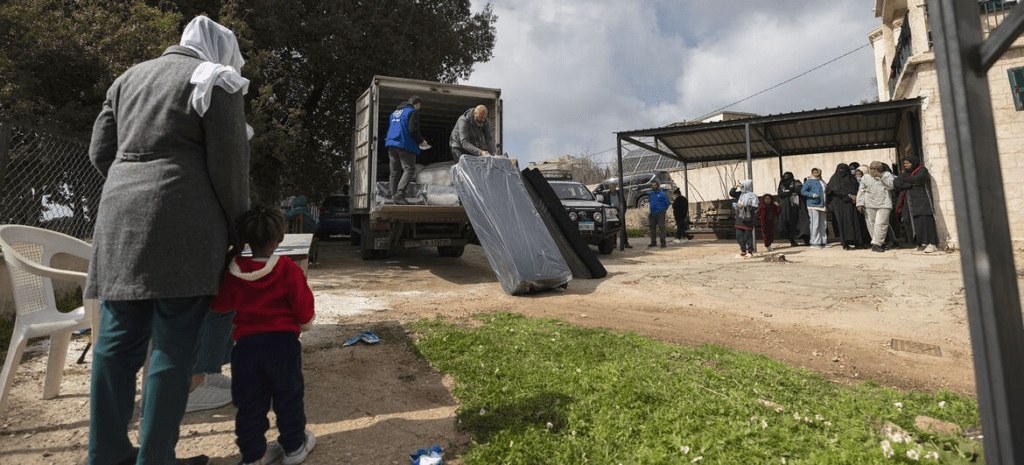
© IOM | Mattresses are distributed to families in Lebanon by the UN migration agency, IOM.
Middle East crisis: UN health agency releases emergency funds for Lebanon, Iraq, Syria
The UN World Health Organization (WHO) is releasing another $2 million in emergency funds to support health systems in Lebanon, Iraq and Syria as strikes against Iran by the US and Israeli continue amid counterstrikes across the Gulf and wider region by Tehran.
The funds based on donor contributions will help strengthen emergency coordination, trauma care and disease surveillance, the UN agency said on Sunday, while also ensuring access to essential medicines and medical supplies.
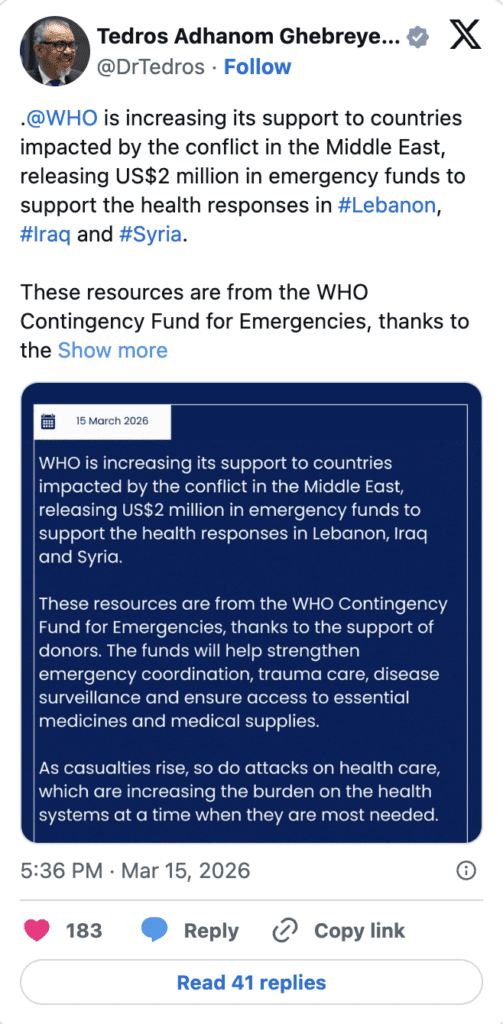
“As casualties rise, so do attacks on healthcare, which are increasing the burden on health systems at a time when they are most needed,” said WHO chief Tedros Adhanom Ghebreyesus in a social media post.
“I urge all parties to choose the brave and life-saving path to peace,” he added.
WHO regional director Dr. Nana Balkhy said at a time when there were already significant cuts to aid, a boost for frontline health workers was essential.
Cash injection
In Lebanon, an increasing number of injuries sustained by the resumption of strikes by Hezbollah militants in support of Iran and devasting counterstrikes from Israel targeting many areas of the south and the capital Beirut, are placing severe strain on healthcare services.
On Saturday, Tedros underlined that the killing of 14 health workers in southern Lebanon over the previous 24 hours marked a “tragic development” in the regional crisis sparked by the US and Israeli decision to launch a full-scale aerial offensive on Iran.
Twelve doctors were killed in a late-night strike on the Bourj Qalauoiyeh primary healthcare centre which two paramedics lost their lives earlier in an attack on a health facility. There have been 27 attacks on healthcare in Lebanon since 2 March, resulting in at least 30 deaths.
In Iraq, services are under increasing pressure – especially in areas near to strike zones and violent demonstrations. The US has provided $500,000 for emergency coordination, mass casualty management and other key services, WHO said.
Before the bombing campaign began against Iran, WHO needed $633 million through its 2026 appeal to meet regional needs. As of March, they had been only 37 per cent funded.
A $500,000 allocation to Syria will support procurement of live-saving medicines and supplies for displaced populations and boost disease surveillance.
Peacekeepers under fire
Peacekeepers serving with the UN mission in southern Lebanon (UNIFIL) monitoring the Blue Line, again came under fire during three separate incidents while on patrol this weekend.
The mission issued a statement saying hostile fire most likely came from “non-State armed groups,” close to their bases in Yatar, Dayr Kifa and Qallawiyah.
“The fire in Yatar hit as close as five metres from the peacekeepers,” the mission said. “Two patrols returned fire in self-defence and after brief exchanges, the patrols resumed their planned activities. No peacekeeper was injured.”
UNIFIL underlined that the use of weapons by any armed groups inside the mission’s area of operations is a violation of Security Council Resolution 1701 which brought an end to hostilities between Israeli forces and Hezbollah in 2006.
UN chief António Guterres just concluded a solidarity visit to Lebanon where he underlined that any attack against UN ‘blue helmets’ and their positions “are completely unacceptable and they must stop.”
During his visit to Beirut, the Secretary-General also met some of the more than 800,000 civilians who have been forced to flee their homes since the fighting began, stressing once again the civilians should never be a target.